Let’s Talk About Healing

Have you ever felt stuck in your own head? Like your thoughts are running a marathon and you’re just trying to catch up? Let’s dive into something that might just change the way we look at mental health: Cognitive Behavioral Therapy, or CBT.
What’s the Big Deal with CBT?
Cognitive Behavioral Therapy isn’t just another fancy psychological term. It’s like a personal trainer for your mind. Imagine having a coach who helps you rewire those negative thought patterns that have been holding you back. That’s CBT in a nutshell.
Most of us walk around with a backpack full of unhelpful thoughts. “I’m not good enough.” “Everything always goes wrong.” “I’ll never succeed.” Sound familiar? CBT is about unpacking that emotional baggage and learning to travel lighter.
The Science of Changing Your Mind
Here’s the thing about our brains: they’re incredible, but they’re also pretty good at playing tricks on us. CBT is based on a simple yet powerful idea—our thoughts aren’t always facts. Just because you think something doesn’t make it true.
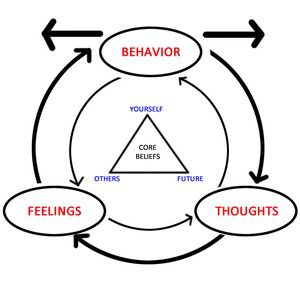
Let’s break it down. CBT works on this revolutionary concept that:
- Our thoughts influence our feelings
- Our feelings drive our behaviors
- Our behaviors then reinforce our thoughts
It’s like a circular dance, and CBT helps you learn the steps to change the rhythm.
Your Mental Health Toolkit

Think of CBT as a practical toolkit for your mind. It’s not about lying on a couch and talking about your childhood for hours (though that has its place). It’s about rolling up your sleeves and doing the work.
In a typical CBT journey, you’ll:
- Identify negative thought patterns
- Challenge those thoughts with evidence
- Learn practical coping strategies
- Set realistic goals
- Practice new ways of thinking and behaving
It’s like cognitive gymnastics—you’re training your brain to be more flexible, more resilient.
Who Can Benefit from CBT?
The beautiful thing about CBT is that it’s not just for people with diagnosed mental health conditions. Sure, it’s incredibly effective for:
- Anxiety disorders
- Depression
- PTSD
- Eating disorders
- Addiction
- Phobias
But it’s also for anyone who wants to:
- Improve their mental resilience
- Build better stress management skills
- Enhance self-esteem
- Develop healthier relationships
- Navigate life’s challenges more effectively
Real-World Impact
Let me tell you something—CBT isn’t just theoretical mumbo-jumbo. It’s scientifically proven, backed by decades of research. Imagine having a method that helps you rewrite your internal narrative, that gives you tools to handle life’s curveballs.

For instance, someone struggling with social anxiety might learn to:
- Recognize their fear-based thoughts
- Challenge those thoughts with rational evidence
- Develop strategies to manage anxiety in social situations
- Gradually expose themselves to feared scenarios, building confidence
It’s not about eliminating negative thoughts completely—that’s impossible. It’s about changing your relationship with those thoughts.
The Journey of Self-Discovery
CBT isn’t a quick fix. It’s not a magic wand that makes everything perfect overnight. It’s a journey of self-discovery, of learning to be your own best friend and most compassionate coach.
You’ll work with a therapist, but the real work happens in your day-to-day life. It’s about practicing new skills, being patient with yourself, and understanding that growth is a process.
Breaking the Stigma

Let’s be real—mental health has been taboo for too long. CBT is part of breaking down those walls. It’s about saying, “It’s okay to not be okay, and it’s even more okay to seek help and work on yourself.”
This isn’t about weakness. This is about strength. The strength to look at your inner world honestly, to challenge yourself, to grow.
Your Mental Health, Your Rules
Choosing to try CBT is like choosing to be the author of your own story. It’s saying, “I’m not going to let my thoughts define me. I’m going to define my thoughts.”
Every person’s journey is different. What works for one might not work exactly the same for another. And that’s perfectly okay. CBT is adaptable, personalized, and fundamentally about empowering you.
Moving Forward Together
Mental health isn’t a solo sport. It’s about connection, understanding, and continuous learning. CBT provides a roadmap, but you’re the one driving.
If you’re feeling stuck, overwhelmed, or just curious about how you can become more resilient, consider exploring Cognitive Behavioral Therapy. It’s not about fixing something that’s broken. It’s about unleashing the incredible potential that’s already within you.
Remember: Your mind is your most powerful asset. Treat it with the care, respect, and training it deserves.