Introduction
The ancient aliens theory, also known as the ancient astronaut theory, proposes that intelligent extraterrestrial beings visited Earth in the distant past and made contact with early humans. This theory suggests that ancient aliens influenced the development of human civilizations by providing advanced knowledge and technologies, and that evidence of these contacts can be found in ancient texts, artifacts, and mysterious megalithic structures.
The idea that Earth was visited by aliens in antiquity first emerged in the late 19th and early 20th centuries, following waves of scientific and technological advancement. Authors such as H.G. Wells and Edward Bulwer-Lytton wrote fictional stories exploring this premise. The theory gained more traction in the 1960s and 1970s, when Erich von Däniken published influential books like Chariots of the Gods? and Gods from Outer Space. These works collected various examples from archaeology, mythology, and biblical scripture that von Däniken claimed demonstrated evidence of ancient astronauts.
The ancient aliens theory posits that many megalithic structures, artifacts, and mythological accounts cannot be adequately explained without the intervention of technologically advanced extraterrestrial beings. Proponents argue that ancient civilizations simply did not have the knowledge or capabilities to construct many architectural marvels like the pyramids of Egypt, megaliths of Stonehenge, or massive stone figures of Easter Island. The theory claims that stories of gods descending from the sky and bestowing knowledge upon humanity are actually distorted memories of ancient alien contact. Overall, the ancient astronaut perspective seeks to rewrite history and archaeology to account for what it believes is undeniable evidence of alien visitors long ago.
Key Proponents and Popularizers
The ancient astronaut theory has been popularized by several authors and personalities over the past several decades. Some of the key figures include:
Erich von Däniken – Von Däniken is widely considered the father of the ancient astronaut theory. His 1968 book Chariots of the Gods? presented various archeological and textual evidence suggesting that extraterrestrials helped advance human civilization.
Zecharia Sitchin – Sitchin focused mainly on ancient Sumerian texts and claimed they described extraterrestrial beings called the Anunnaki who came to Earth from the planet Nibiru to mine gold and created humans through genetic engineering to serve as workers. His books include The 12th Planet, The Lost Realms, and The End of Days.
Giorgio A. Tsoukalos – Tsoukalos is the leading contemporary popularizer of ancient astronaut theories. As an alien expert on the TV series Ancient Aliens, he often concludes that ancient evidence can only be explained by advanced extraterrestrial technology and visitations.
David Childress – Childress is an author who focuses on unusual phenomena and unexplained mysteries from human history. His books promote ancient astronaut theories about advanced civilizations and extraterrestrial interventions.
Major publications and TV shows have also brought ancient astronaut theories to wider audiences. Erich von Däniken’s Chariots of the Gods? was a global bestseller. The TV series Ancient Aliens has aired over 200 episodes on the History Channel since 2009. Overall, these proponents argue human development has been guided by extraterrestrial intelligences.
Ancient Astronaut Theories
According to proponents of ancient astronaut theories, alien visitors have interacted with human civilizations for thousands of years. These theories often claim that extraterrestrials visited Earth in the distant past and influenced human evolution and civilization in various ways. Some key themes and assertions include:
- Visitations by extraterrestrial beings in ancient times: Many ancient astronaut theories argue that aliens visited Earth and interacted with early human societies in the distant past. Proponents cite various archaeological sites, ancient artwork, and religious texts as evidence of contact with advanced extraterrestrial visitors in ancient times. Some argue Stonehenge, the Pyramids of Giza, and other megalithic sites were constructed under guidance from alien visitors.
- Involvement of aliens in human evolution: Some ancient astronaut theorists contend that extraterrestrials intervened in human evolution through genetic engineering or cross-breeding with early hominids. This notion speculate that aliens upgraded human intelligence and accelerated the development of civilization.
- Ancient myths interpreted as encounters with aliens: Many ancient myths and legends are reinterpreted within ancient astronaut frameworks as depictions of contact with extraterrestrial visitors. Myths regarding gods descending from the sky are seen as early records of visitations by alien astronauts.
- Advanced ancient technology attributed to aliens: Impressive or mysterious ancient technologies and artifacts are sometimes attributed to sharing of knowledge from extraterrestrial civilizations to early human societies. Theories argue advanced technologies like the Antikythera mechanism were influenced by knowledge provided by alien visitors.
Overall, ancient astronaut theories commonly argue human civilization was shaped or accelerated by direct contact with extraterrestrial intelligences in the distant past. While hotly debated, these unconventional perspectives remain influential in some circles.
Purported Evidence and Artifacts
Proponents of ancient astronaut theories point to various archaeological sites and artifacts as evidence that extraterrestrials visited Earth and influenced human civilizations. Some of the more well-known examples include:
Puma Punku
Puma Punku is part of a large temple complex in Bolivia that dates back to the 6th century AD. The precision stonemasonry at the site has puzzled archaeologists, as the blocks were cut with laser-like accuracy. Ancient astronaut theorists believe such precision could only have been achieved with advanced alien technology.
Gobekli Tepe
Gobekli Tepe in Turkey contains carved stone pillars and structures dating back to the 10th millennium BC, predating Stonehenge and the pyramids of Egypt. Ancient astronaut theorists claim its architectural complexity indicates it was built by hunter-gatherers with access to advanced knowledge.
Nazca Lines
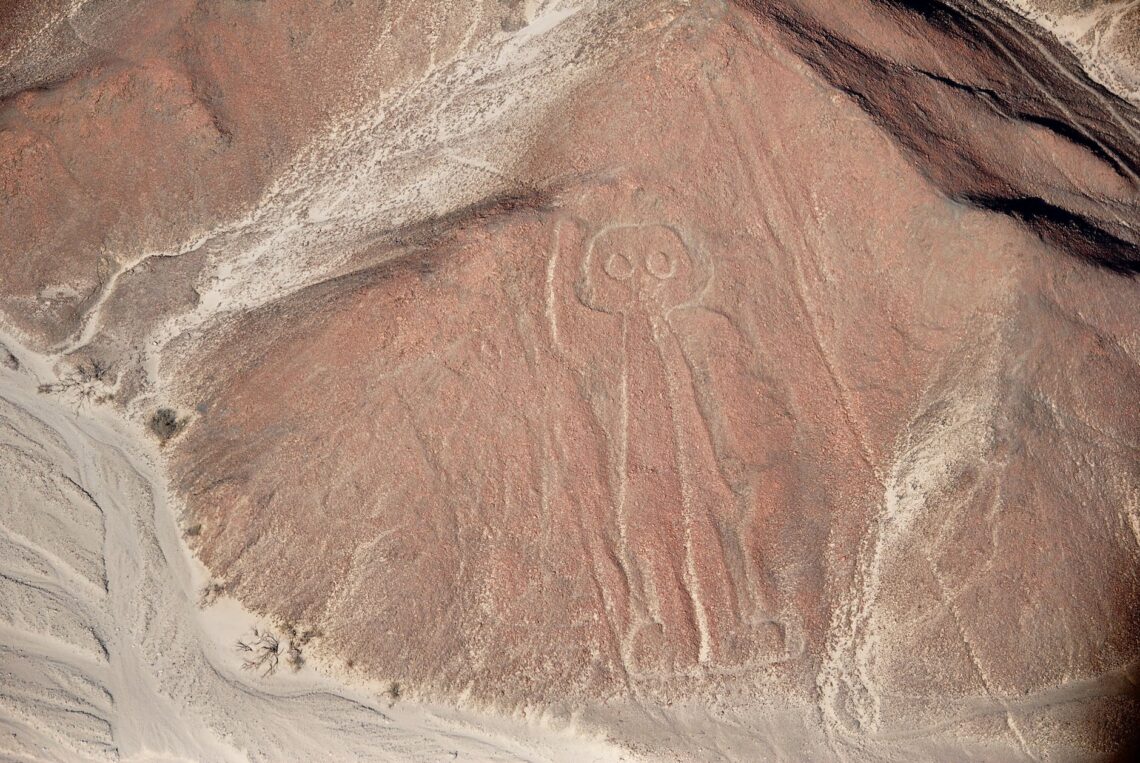
The famous Nazca Lines of Peru consist of giant geoglyphs only visible from the air. Ancient astronaut theorists posit they were created to serve as runways and landing strips for spacecraft, or as messages to the extraterrestrial “gods”.
Vimana Aircraft
Ancient Sanskrit texts describe vimana, or mythical flying palaces and chariots. Proponents believe they were actually advanced aircraft given to ancient humans by extraterrestrials.
Ancient Art Depicting ‘Astronauts’
Rock paintings, petroglyphs, and artifacts from around the world seem to depict figures wearing what look like modern spacesuits and helmets. Advocates claim this offers evidence of ancient alien encounters.
Out-of-Place Artifacts
Some artifacts like the Antikythera mechanism, Baghdad battery, and crystal skulls seem advanced beyond what should have been possible at their time. Ancient astronaut theorists think they are evidence of alien technology.
Evolutionary Impact Claims
Some ancient astronaut theorists argue that extraterrestrials intervened in human evolution through genetic engineering and hybridization. They claim humans experienced sudden evolutionary leaps and accelerated development due to alien intervention and experimentation.
Specific theories include:
- Humanity arose from hybridization between alien visitors and early hominids. Proponents claim some human genetic code contains evidence of engineering by extraterrestrial “star farmers.”
- Key evolutionary milestones like increased brain size, loss of body hair, and upright walking resulted from alien genetic modification and experimentation with proto-humans.
- Aliens introduced advanced intelligence to early humans through interbreeding. Theorists argue humans could not have evolved such high intelligence naturally in such a short span of evolutionary time.
- Humanity’s “missing link” remains elusive in the fossil record because aliens orchestrated sudden jumps in hominid evolution. Mainstream science can’t explain these rapid evolutionary leaps.
- Aliens genetically engineered modern Homo sapiens as a slave race to serve them. Our advanced cognitive abilities were given by aliens to make humans useful workers.
- Interventions in human evolution allowed extraterrestrials to create suitable vessels and hybrids through which they could incarnate on Earth. Some theorists embrace psychic or spiritual aspects in human-alien communion.
Skeptics argue there is no solid scientific evidence for such conjectures. Mainstream evolutionary science holds that humans evolved gradually over millions of years through natural selection like all life on Earth. Any sudden evolutionary leaps are explainable by existing evolutionary theory and models.
Criticisms and Counter-Arguments
The ancient astronaut theory has been widely criticized by academics, scientists, historians and archaeologists who find no convincing evidence to support the notion that intelligent extraterrestrials visited Earth in the past. The main criticisms are:
Lack of direct evidence – There is no archaeological evidence that directly points to the involvement of aliens. Artifacts and sites referenced by ancient astronaut theorists have more plausible, Earth-based explanations. Theorists rely heavily on speculation and presupposition rather than physical proof.
Faulty logic and pseudoarchaeology – Logical fallacies, cherry-picked data, unsupported conjectures and speculative pseudoscientific methods are used to make the evidence fit the ancient astronaut premise, rather than sound objective analysis.
Cherry-picking data – Only select archaeological discoveries and ancient texts are cited by theorists, while ignoring the wider body of knowledge and evidence that undermines or disproves the ancient astronaut theory. There is confirmation bias in play.
Conflation of myth and reality – Myths are imaginative stories passed down over generations that often contain supernatural elements. Ancient astronaut theorists interpret myths, legends and symbols as literal accounts of alien visitations, rather than allegorical tales open to multiple interpretations.
Alternative explanations – Mysterious ancient sites and artifacts have more plausible conventional origins or purposes. For example, Nazca lines served as ceremonial and astronomical functions for the Nazca culture; the Egyptian pyramids were elaborate tombs built with primitive yet effective technologies, without aliens.
Interpretations of Ancient Texts
Some proponents of ancient astronaut theories argue that certain ancient texts describe extraterrestrial contact and technologies. They cite various interpretations of ancient mythologies and scriptures to support the idea that ancient humans interacted with alien visitors.
For example, Zecharia Sitchin claimed that Sumerian clay tablets describe how an alien race called the Anunnaki came to Earth from the planet Nibiru and created the human race through genetic engineering. Sitchin believed the tablets describe how the Anunnaki taught humans agriculture, language, and technology. However, most mainstream scholars reject Sitchin’s translations and interpretations as pseudohistory.
Sections of the ancient Hindu text known as the Mahabharata have also been interpreted by some as depicting nuclear warfare, advanced weaponry, and flying machines called Vimanas. While these descriptions are open to interpretation, mainstream academics attribute them to poetic imagination and mythology as opposed to literal alien technology.
The biblical Book of Ezekiel contains visions that some have connected to ancient astronauts, such as a flying chariot said to be powered by wings and wheels. Most biblical scholars, however, view these as symbolic visions rather than literal alien spacecraft.
Some Mayan artifacts and stone inscriptions have designs that ancient astronaut theorists believe depict extraterrestrials and spaceships. Mainstream archeologists do not interpret these images so literally, instead seeing representations of mythological creatures and gods.
Overall, the interpretation of ancient religious and historical texts suffers from confirmation bias among ancient astronaut proponents seeking evidence for their theories. Academic experts strongly caution against taking mythological stories and metaphors as literal evidence of alien contact. While ancient texts offer much room for imaginative interpretation, ascribing their stories directly to extraterrestrials remains highly speculative.
Influence on Popular Culture
The Ancient Astronaut theory has had a significant influence on popular culture, appearing in numerous books, films, video games, and other media. Some examples include:
- Science fiction books and films like 2001: A Space Odyssey, Stargate, and Prometheus, which were directly inspired by Ancient Astronaut ideas. The theory is frequently used as a plot device or backstory.
- Video games such as the Assassin’s Creed and Halo franchises contain overt Ancient Astronaut references and lore. These games incorporate the idea of advanced precursor civilizations seeding human life and technology.
- Internet meme culture often jokingly attributes ancient technological achievements to aliens. Memes will caption ancient art or architecture with phrases like “Aliens did it” or “It was aliens”.
- Numerous TV documentaries, specials, and shows have covered the Ancient Astronaut theory and its proponents like Erich von Däniken and Giorgio A. Tsoukalos. The History Channel’s Ancient Aliens series popularized the theory for modern audiences.
- Films like Alien vs. Predator directly combine the idea of alien visitations and interactions with early human civilization. Other franchises like Indiana Jones reference the theory as part of their story and lore as well.
- Figures like Giorgio A. Tsoukalos have become pop culture celebrities largely due to their association with Ancient Astronaut ideas and meme status. Tsoukalos in particular is strongly linked to the “Aliens” meme.
So in summary, the Ancient Astronaut theory has broadly disseminated into popular culture across mediums, often portrayed positively or humorously rather than critically. It provides creative inspiration and backstory context for many fictional universes.
Conclusions
The “ancient astronaut” theory, which states that intelligent extraterrestrial beings visited Earth in the distant past and influenced human civilization, remains a controversial idea. There is a passionate community of believers, but most mainstream academics consider the evidence unconvincing.
Key points that have been covered in this article include:
- Many ancient myths and texts describe gods, angels, or other supernatural beings interacting with humans and providing advanced knowledge. Some interpret these literally as evidence of alien contact.
- Ancient sites like Pyramids and Stonehenge seem to demonstrate advanced engineering capabilities beyond what should have been possible at the time. Proponents argue this shows influence from extraterrestrials.
- Artifacts like the Antikythera mechanism and the Baghdad battery suggest ancient people had access to sophisticated technology, which could have been given to them by aliens.
- Changes and advancements in human evolution and civilization occurred rapidly, faster than expected through natural selection. Ancient astronaut theorists contend aliens intervened to accelerate our development.
- Mainstream academics mostly reject these ideas due to lack of direct archeological evidence, the potential of cultural bias in interpreting myths, and more mundane explanations for artifacts and ancient engineering feats.
Further research with scientific rigor is necessary to uncover more evidence and determine if any extraterrestrial involvement may have occurred. More interdisciplinary analysis should be done on global myths and texts for common themes. Discoveries of potential new artifacts would also further inform the debate. Stronger evidence than what currently exists is needed to prove any direct influence by ancient aliens on humanity. The theory remains speculative and inconclusive without new data.
References
List of citations for sources used in article:
- Erich von Däniken. Chariots of the Gods?. Berkley Books, 1999. Originally published 1968.
- Zecharia Sitchin. The 12th Planet. Harper, 2007. Originally published 1976.
- Giorgio A. Tsoukalos. Alien Cosmic Expo. History Channel), 2009-2011.
- Jason Colavito. The Cult of Alien Gods: H.P. Lovecraft And Extraterrestrial Pop Culture. Prometheus Books, 2005.
Discover more from Whispers of Insight
Subscribe to get the latest posts sent to your email.