
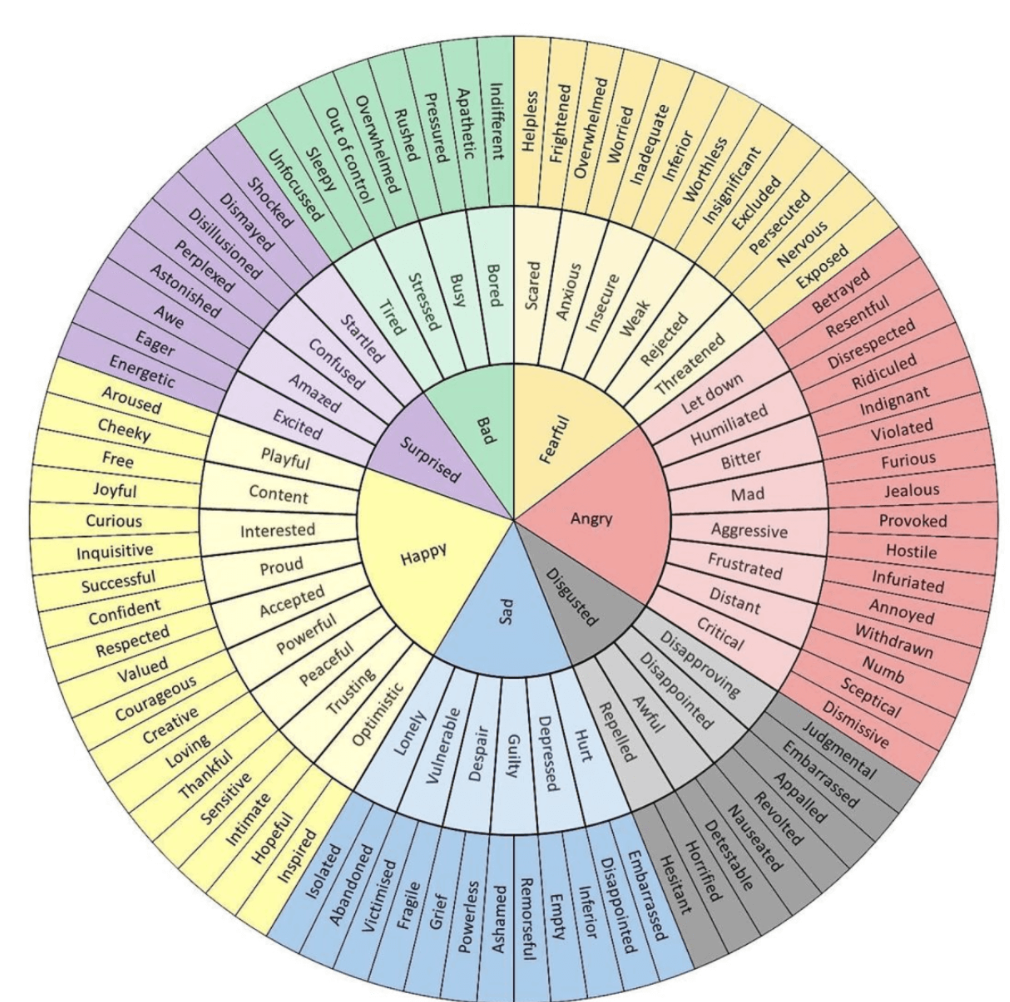
Emotions. I think it’s safe to say that a majority of people experience emotions subconsciously, at least until they or the effects they cause become dramatic. I’ve always had an intuition that the unexamined emotional landscape is a force that is in control of one’s journey. In order to take back control, one needs to become aware of the interplay of emotions one experiences in the day, bringing this awareness to the conscious mind. In order to do that, a person must recognize the emotions they are experiencing first. I think for most people, that is the most difficult part. Truly feeling our emotions and getting real about which emotions we are feeling. For many, it’s a sign of weakness or vulnerability; which I will be posting about soon, hopefully!
 |
| Sydtomcat, CC BY-SA 4.0, via Wikimedia Commons |
Last week, I learned about the complex interplay of emotions as a result of triggers, otherwise called ‘prompting events.’ A prompting event is pretty self-explanatory, it is something that triggers an emotional reaction. This emotional reaction can result in biological changes and urges to act, and typically in the unexamined mind, it will lead to action. This action causes after-effects. This sounds pretty linear, but you can have multiple emotions involved in this drama.
When multiple emotions come into this reaction chain, it can look very complicated and often involves or leads to the involvement of others; this has been my experience. You may be wondering what this looks like, so let’s walk through an example.
Imagine you are walking alone in a dark, unfamiliar area, and you suddenly hear a loud, unexpected noise. Your primary emotion in this situation might be fear, triggered by the perceived threat or danger. As a result of this fear, you might start to feel anxious. The anxiety, in this case, is the secondary emotion that arises from the primary emotion of fear. You become anxious about what might happen next, the source of the noise, and how to stay safe in the situation.
Here is another example that may better illustrate the scenario for some folks:
Suppose you have an argument with a close friend and say hurtful things in the heat of the moment. Your primary emotion in this scenario could be anger, directed at your friend or the situation. After the argument has subsided, you may start to feel guilty as a secondary emotion. You regret the hurtful words you said and feel remorse for potentially damaging the relationship, which can lead to feelings of guilt.
When you notice an emotion, there is a chain of events that happens that causes biological changes in our body. When you’re angry, your heart starts racing, and your face may flush, as your body’s fight-or-flight response is activated. This response involves the release of stress hormones like adrenaline, which prepare your body for action. Your muscles may tense, and your breathing may become more rapid. These physiological changes are part of the body’s way of responding to the emotional experience and preparing you to deal with the perceived threat or challenge. This interconnected relationship between emotions and our physical responses demonstrates the intricate connection between our mind and body, emphasizing the profound impact of emotions on our overall well-being.
Often, when we experience strong emotions, they can lead to action urges, and when unchecked, these urges will lead to action. When we allow ourselves to behave in these ways subconsciously, the resulting behavior can often lead to secondary emotions.
For instance, when feeling intense anger, the action urge might be to shout or express frustration physically. If this urge is acted upon, it can lead to a subsequent feeling of regret or guilt (secondary emotion) after realizing the consequences of one’s actions. Therefore, understanding and managing both the initial emotional responses and the subsequent actions can play a crucial role in emotional well-being and interpersonal relationships.

When thinking about my past relationships and experiences while living with BPD, especially pre-diagnosis, it’s obvious to me that my emotions were leading to many of my behaviors. After everything settled, I was filled with a lot of regret, shame, remorse, etc. Despite the negative emotional out come, it’s very little solace for those who’ve been affected by my behavior. It can be difficult to reconcile after such disputes.
I’m working on that now, with several people who I hope will continue to be a part of my life. However, when I reach out it seems as though many are unreceptive. I am trying to understand from their perspective to bring more insight for myself. I think a lot of it is just that words only mean so much to most people. I can tell people I am choosing a different, healthier path, but ultimately I think many are expecting me to prove it. Either way, it’s not only a difficult thing for me to process, but I am trying to think of it as incentive. Not only to reconnect old relationships but also for the benefit of the new relationships I hope to build in the future.
There’s always work to do, and there will always be work. I think that can be said for anyone. I have another blog post to write, so I am going to get started on that. Hopefully I am able to finish it soon because I also need to put more hours in at my current job. I also have several websites to revamp. The comment about work stands with both metaphor and literally, I suppose. heh
Take care.
Discover more from Whispers of Insight
Subscribe to get the latest posts sent to your email.